
As part of the Monumental Challenges project (2023–2025), led by EuroClio – the European Association of History Educators, our team developed teaching materials on contested monuments around the world. At the time, we could not have anticipated how timely and significant these debates over global controversies would become. Nor could we have foreseen how related political developments would unfold, or how the issues we raised would resonate in today’s social and political landscape.
The aim of the project was not to respond to day-to-day political events, but to use history and civic education to foster historical consciousness and an understanding of contested historical legacies. We started from the belief that collective memory, identity, and power are inseparable, and that any understanding of the past is inseparably connected to the present. In this sense, the teaching materials were designed to contribute to education for democracy, encouraging students to critically question dominant narratives, consider diverse perspectives, and develop the skills needed for active and responsible participation in contemporary democratic societies.
There were a number of reasons for preparing the lesson plan about Hans Egede Statue : local incidents in Belgrade, where several important monuments were vandalized over the weekend of 24–26 January 2026; students’ interest in learning more about Greenland in a global context; and the Monumental Challenges teaching materials themselves, which explore contested monuments worldwide.
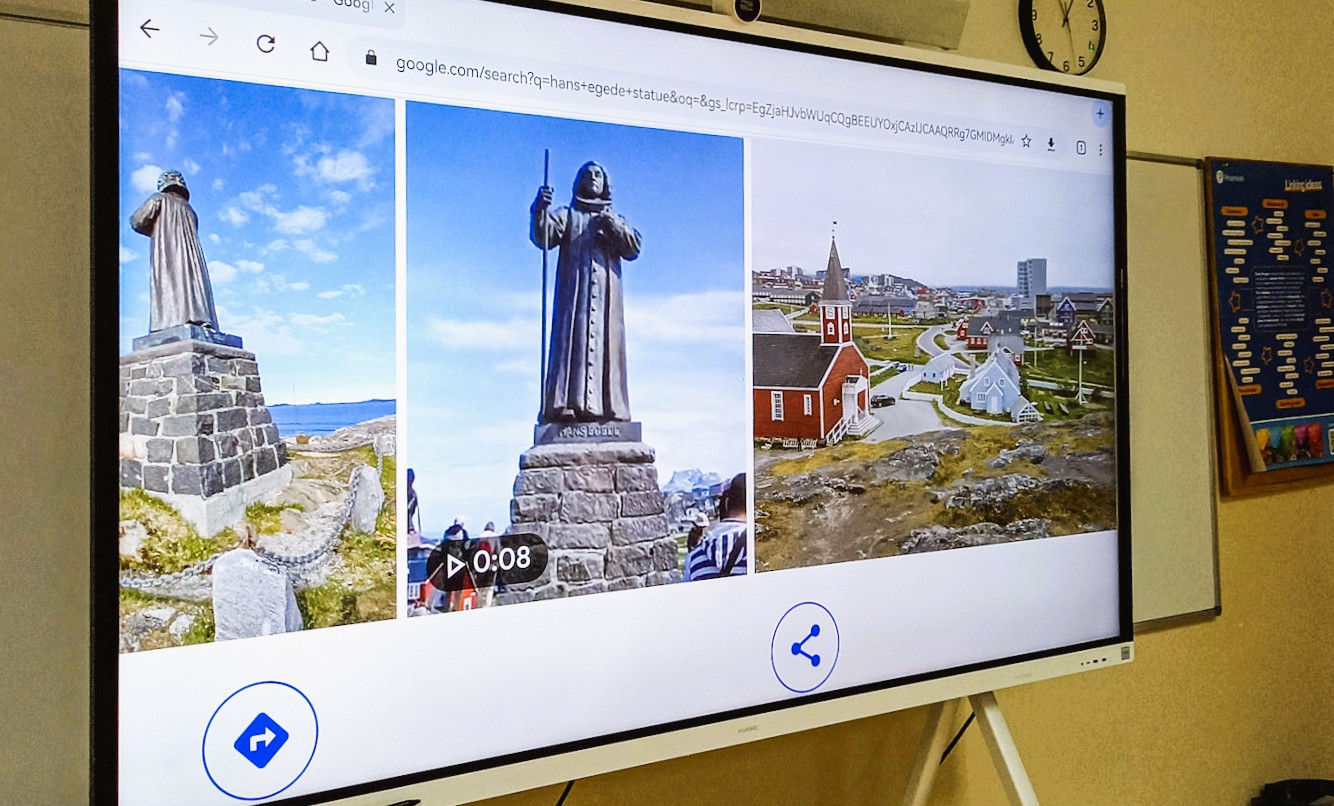
The first step involved a lesson plan from the Monumental Challenges project, centered on the Statue of Hans Egede in Nuuk, Greenland, and its vandalization during protests in 2021.The lesson was adapted for the second-year civic education curriculum with an emphasis on media, partially incorporating text from the Monumental Challenges materials about the monument. Students were shown images of the statue in Nuuk and Copenhagen, along with a summary of key facts about Hans Egede’s life.
When students saw the photographs of the Egede statue doused in red paint, they immediately recognized the parallel with the recent event in Belgrade, where the statue of Gavrilo Princip had been similarly defaced that same weekend. This served as a starting point for discussion on monuments in public spaces and how they provoke contestation among different social groups.
At the start of the lesson, students were provided with a brief text on Hans Egede and the historical context of Greenland, which served as a foundation for practical work and the development of media literacy skills.
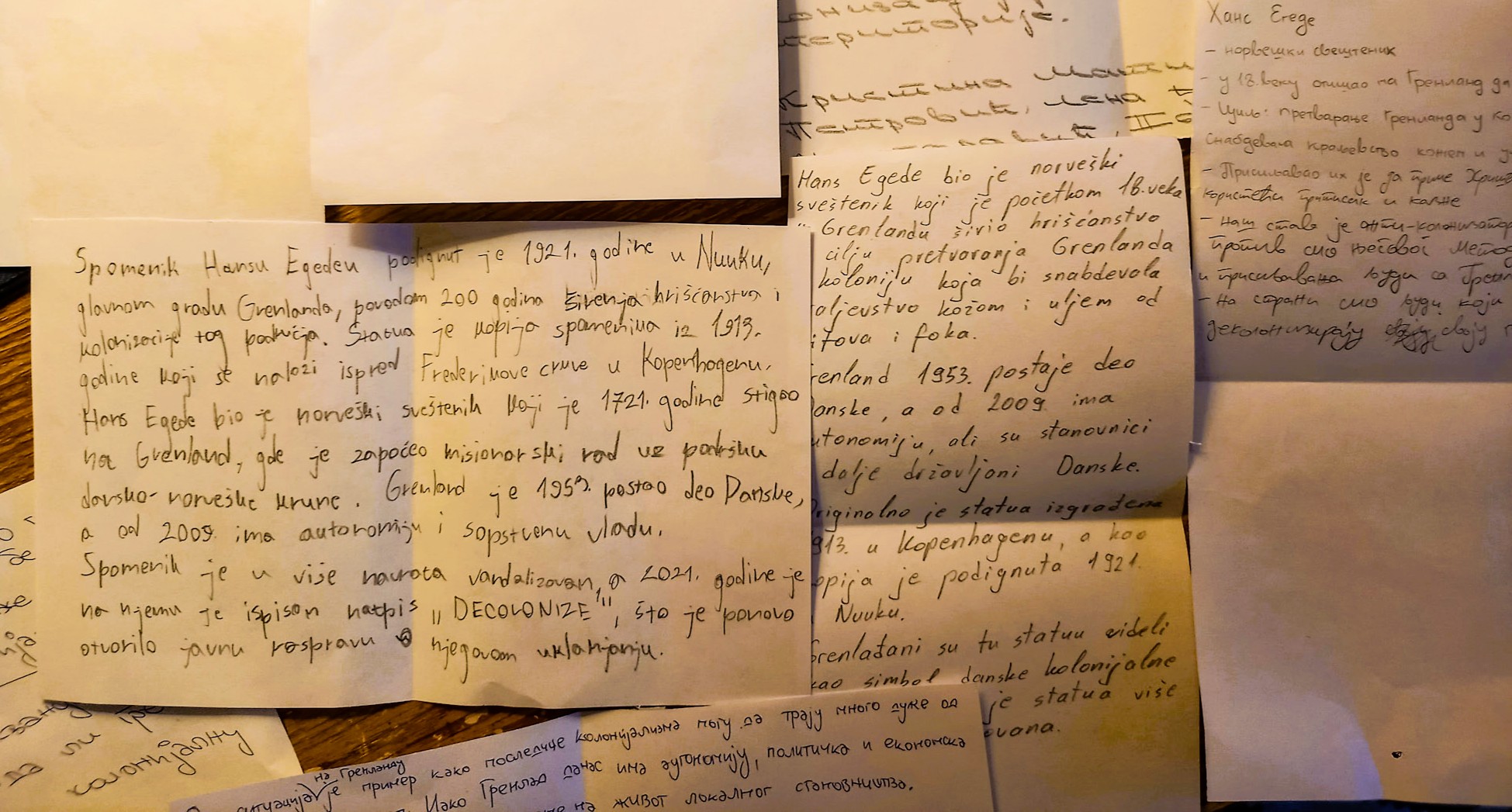
Students’ tasks included writing different types of news stories about the Hans Egede statue:
-
Neutral report – objective presentation of facts
-
Clickbait version – sensational headline and lead
-
Biased/propaganda version – favoring one perspective
-
Column/personal opinion – reflection and argumentation
This approach allowed students to see how historical perspectives can be interpreted and presented differently in the media, to distinguish facts from value judgments, and to develop critical thinking in a contemporary media context.
The lesson resulted in high engagement, dynamic discussion, and students’ ability to analyze and produce information in line with the style and purpose of different journalistic formats.
All three classes conducted within the civic education framework demonstrated the relevance of the materials developed in the Monumental Challenges project. Although the activities were adapted for the local context in Serbia, they clearly showed that history, when taught through perspectives, controversies, and practical skills such as debating, media literacy, and other engaging methods, becomes both effective and appealing for students in understanding the present moment and complex social and historical phenomena.