STUDENT BLOCKADES
by Beotura
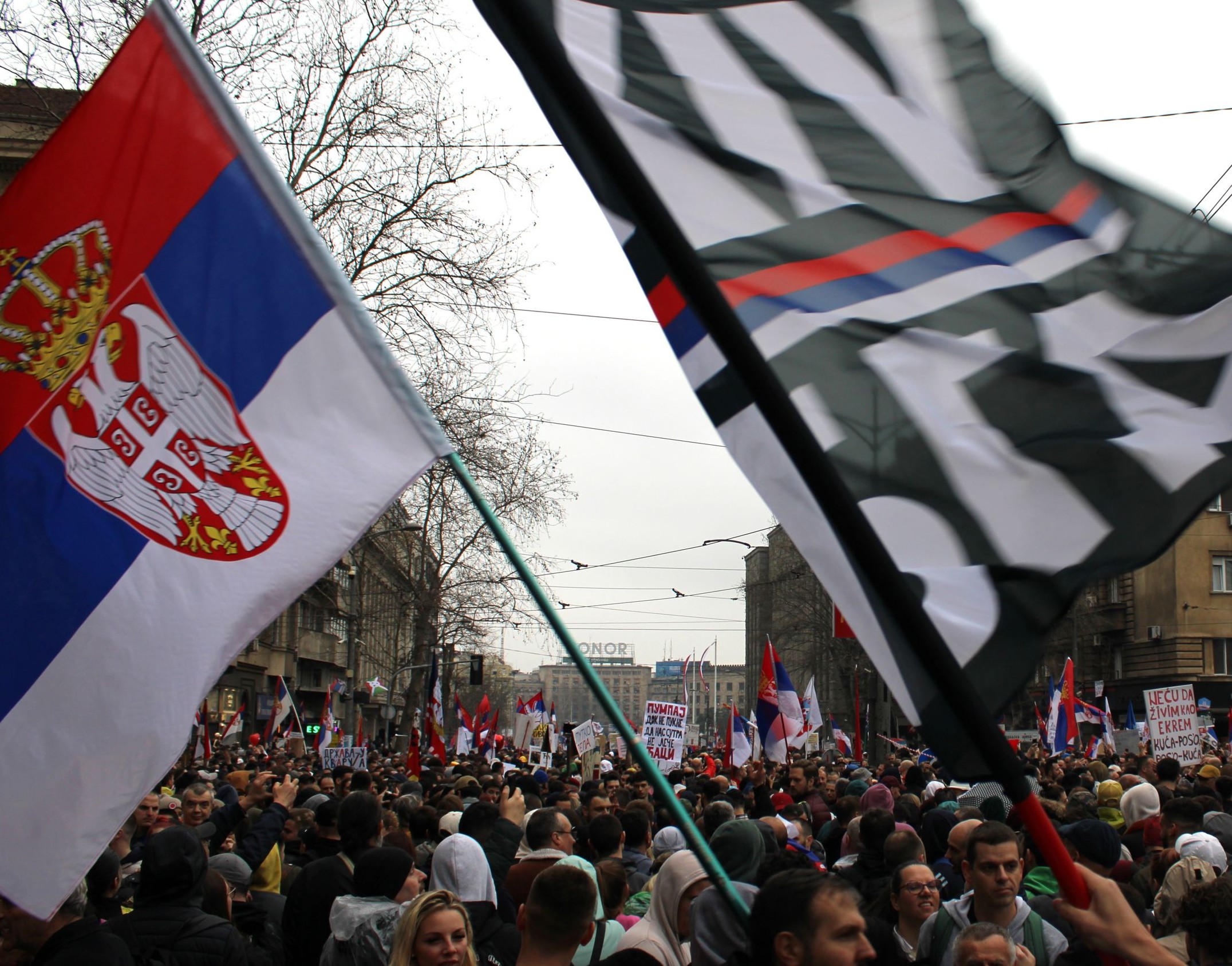
Mass student protests marked the end of 2024 and the first half of 2025 in Serbia.
The wave of demonstrations began when university students initiated blockades of their faculties, soon joined by high school students, teachers, and citizens.The immediate trigger for the blockades was a violent incident on November 22, 2024, when students and professors of the Faculty of Dramatic Arts in Belgrade gathered near the faculty to pay tribute to the victims of the tragedy in Novi Sad. During the gathering — which had been announced in advance — they were physically attacked by an organized group of individuals. Two students sustained minor injuries in the attack.
The incident, coupled with the lack of response from the police and prosecution, provoked strong reactions from the academic community and the broader public. By December 2, 2024, the Faculty of Dramatic Arts had gone into blockade, and on the same day, the building of the University of Belgrade’s Rectorate was also occupied. They were soon joined by the Faculties of Philosophy, Philology, Chemistry, and Mathematics.
The background of the protests lay in the tragedy that occurred on November 1, 2024, when the collapse of a massive concrete canopy — part of the recently renovated main railway station building in Novi Sad — claimed 16 lives. The disaster exposed deep systemic problems within the state: controversial infrastructure projects, widespread corruption, dysfunctional institutions, and a lack of media freedom.
COVER-UP, VIOLENCE, AND THE UNIVERSITY’S RESPONSE
In the days following the tragedy, state institutions attempted to downplay their responsibility through contradictory statements — such as denying that the collapsed canopy had been part of the reconstruction — and by releasing incomplete construction documentation.
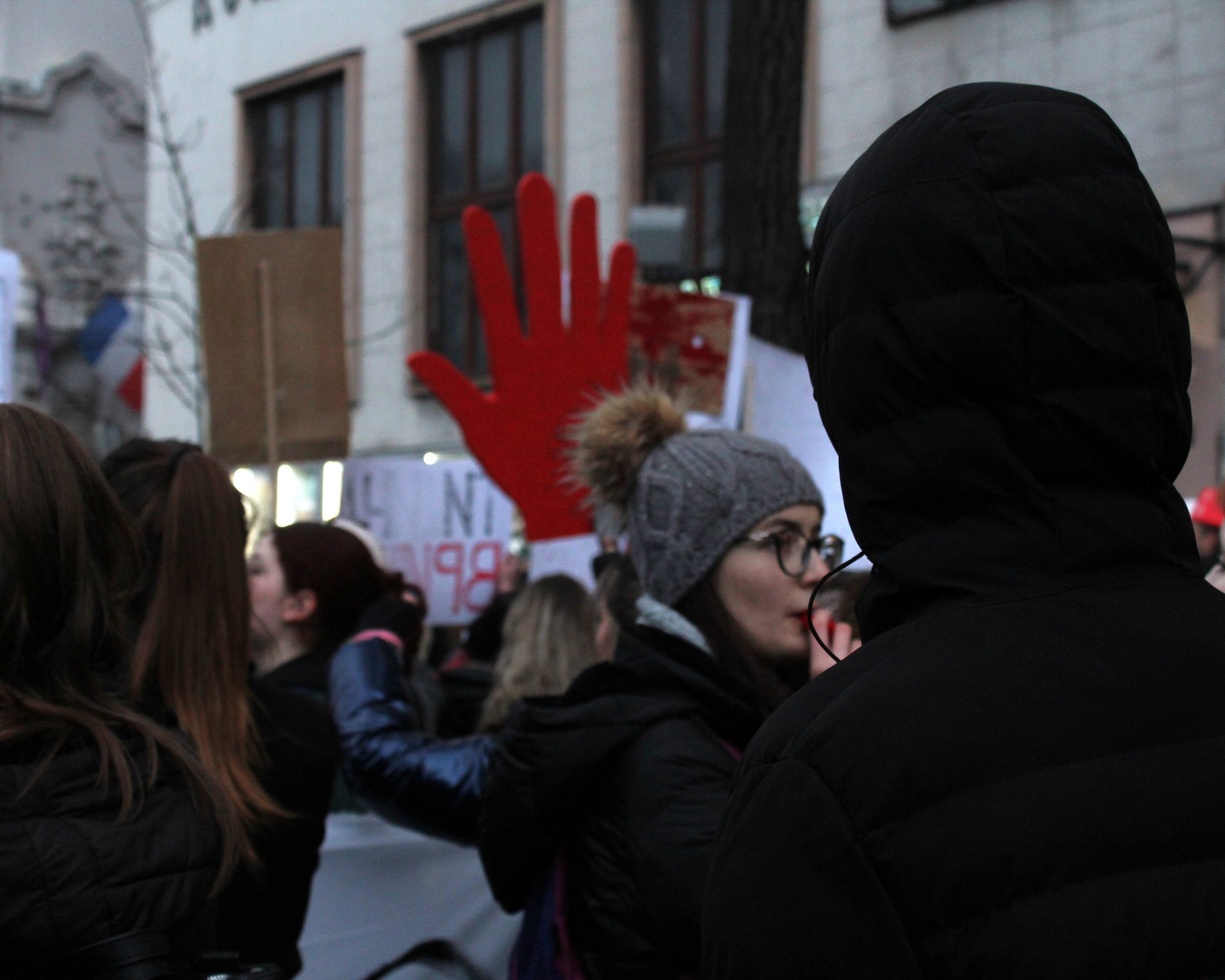
A wave of sporadic protests began with a gathering in Novi Sad, which ended with several student arrests following violent incidents. The inadequate response from institutions and the media prompted students of the Faculty of Dramatic Arts (FDA) to assemble on November 22, 2024, near their faculty to commemorate the 15 victims. During that gathering, students and professors were physically attacked by an organized group.
Four days after the incident, FDA students launched a faculty blockade in protest of the police and prosecutor’s failure to respond. The blockade officially began on December 2, 2024 — the same day the University of Belgrade’s Rectorate building was occupied. Soon, students from the Faculties of Philosophy, Philology, Chemistry, and Mathematics joined the movement.
On December 4, 2024, the University of Belgrade’s Rectorate Council publicly confirmed the blockade of the Rectorate building but expressed support for the students’ right to freedom of thought and expression — including critical thinking as an inalienable right of individuals in a democratic society, and especially within the academic community.
In doing so, the university recognized both the students’ right to protest and their specific demands, which had been formulated through open student assemblies (plenums):
-
Full publication of all documentation related to the reconstruction of Novi Sad’s railway station.
-
Release of arrested student demonstrators and dismissal of all charges.
-
Accountability for attacks on demonstrators.
-
A 20% increase in state funding for universities.
On March 16, students added another demand — a full investigation into the unexplained sound that caused panic and a stampede during the mass protest on March 15. That evening, at 7:11 p.m., during a 16-minute moment of silence to honor the victims, panic broke out along Kralja Milana Street, injuring dozens.
The following day, March 17, students introduced a new demand: accountability for the mishandling of patients transferred from Kočani, North Macedonia, who were being treated at the intensive care unit of the University Clinical Center of Serbia. During the visit of the President of Serbia and accompanying journalists to severely injured patients, students accused the government of violating patients’ rights and exploiting the victims for political purposes.
From the very beginning, the student protests drew massive participation — not only from state universities but also from private ones. More than 60 faculties and higher education institutions across Serbia joined the blockade movement.
FROM BLOCKADE TO ACTION
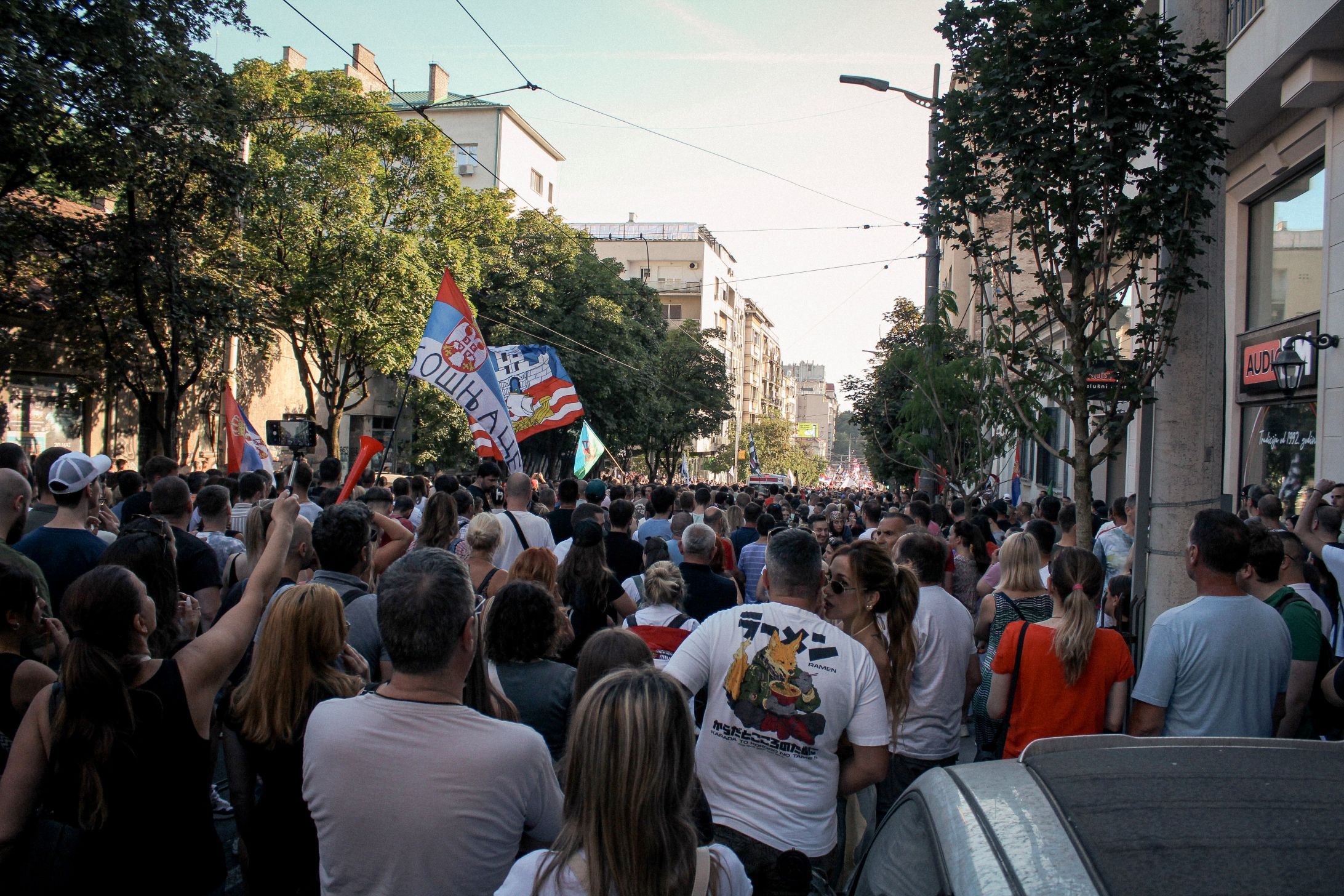
Student actions began on December 11 in front of the Presidential Palace, where, during a live national broadcast by the President of Serbia, students held a loud protest. The movement continued through numerous large-scale and long-lasting actions, joined by teachers, the IT community, farmers, lawyers, healthcare workers, and citizens from across the country.
By mid-December, the wave of protests had spread to schools — starting with gymnasiums — where students launched school blockades that led to the early end of the first semester. The participation of high school students, including minors, reflected the deep discontent felt especially among young people.
The mass protests culminated on December 22, 2024, at Slavija Square in Belgrade, where around 100,000 people gathered — a clear reflection of Serbia’s growing social crisis.
However, the government’s response revealed systemic issues and its inability to engage with citizens’ legitimate demands. Instead of dialogue or reform, the ruling party organized a rally on January 24, 2025, in Jagodina, where President Aleksandar Vučić announced the creation of a “Movement for the People and the State.” This move aimed to consolidate ruling forces and mobilize supporters but further deepened the country’s polarization.
That same day, Belgrade saw a “general strike,” with business owners, educators, lawyers, cultural workers, and others halting operations in solidarity. Many shops, restaurants, cafés, bookstores, and cinemas closed their doors in protest.
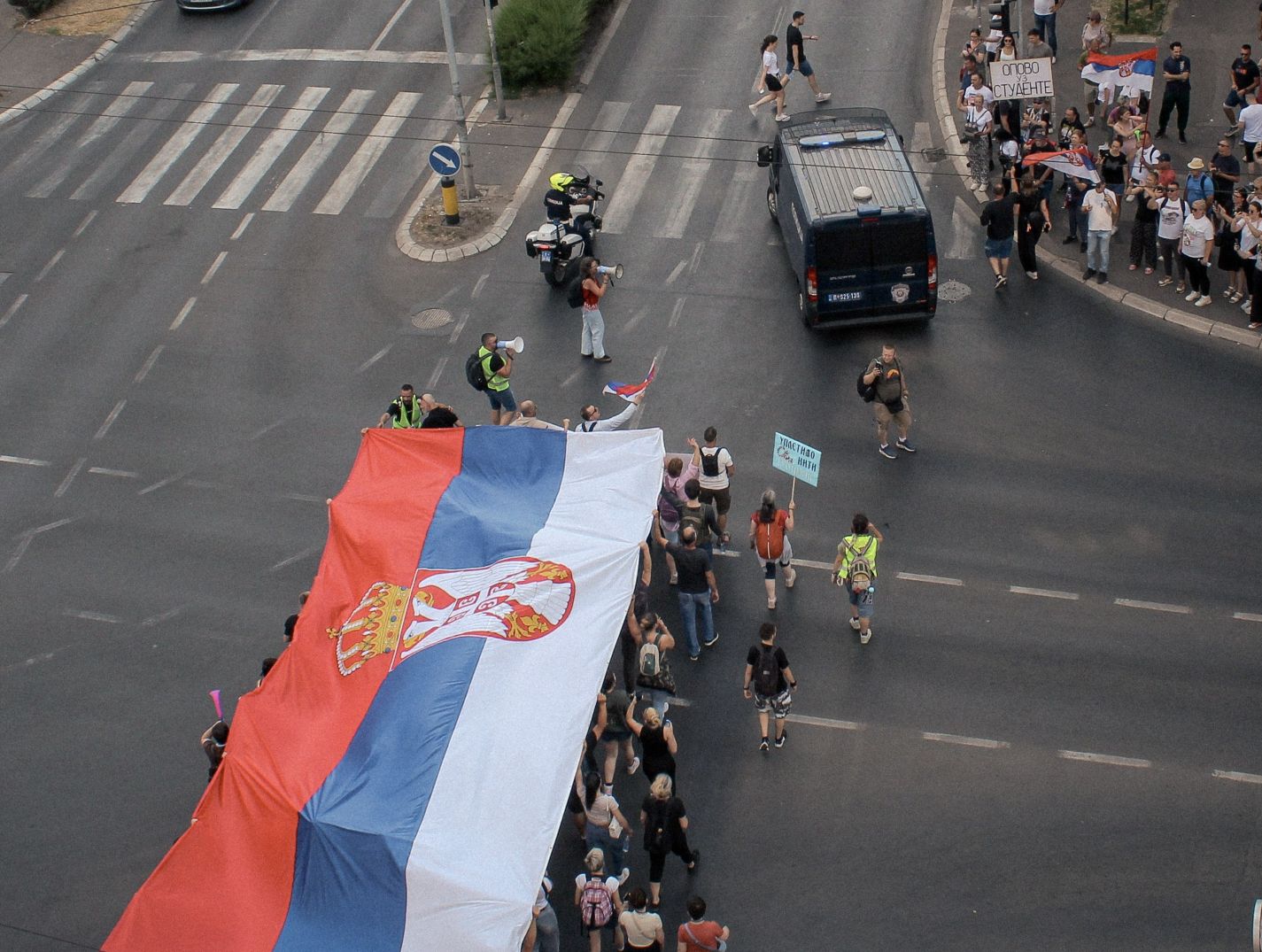
On January 27 — St. Sava’s Day, celebrated as Serbia’s Education Day — students under blockade organized their first 24-hour protest action, titled “Under Our (Auto)Command,” blocking the major Autokomanda traffic junction in Belgrade. The event honored education as one of society’s highest values. The blockade, organized with precision and community participation, lasted exactly 24 hours and concluded peacefully, showcasing the students’ impressive logistical coordination and civic discipline.
POLITICAL UPHEAVAL AND THE STUDENT DECLARATION
At the end of January, Prime Minister Miloš Vučević and Novi Sad Mayor Milan Đurić resigned, a day after a group of men brutally attacked students in Novi Sad, leaving one student severely injured. In response, students marched on foot from Belgrade to Novi Sad, where they blocked bridges — including the Freedom Bridge — for more than a day.
February was marked by large-scale student marches from various Serbian cities toward Kragujevac, culminating in the February 15 action “Let’s Meet on Sretenje.” The event — named after Serbia’s Statehood Day, when the first constitution was adopted — brought together students from Belgrade, Novi Sad, Niš, Novi Pazar, and other cities. Depending on their departure point, participants walked 100–150 kilometers over four days, symbolizing unity and endurance.
In March, the protests continued. Responding to an invitation from the University of Niš, students and citizens gathered on March 1 for the “Student Edict” — an 18-hour protest (reflecting Niš’s area code, 018). The event concluded at King Milan Square, where students read the Student Edict — a symbolic declaration proclaiming freedom, justice, knowledge, dignity, and solidarity as the foundational values of a fairer and more democratic Serbia.
“15 FOR 15” – TURNING POINT FOR A CIVIC ALLIANCE
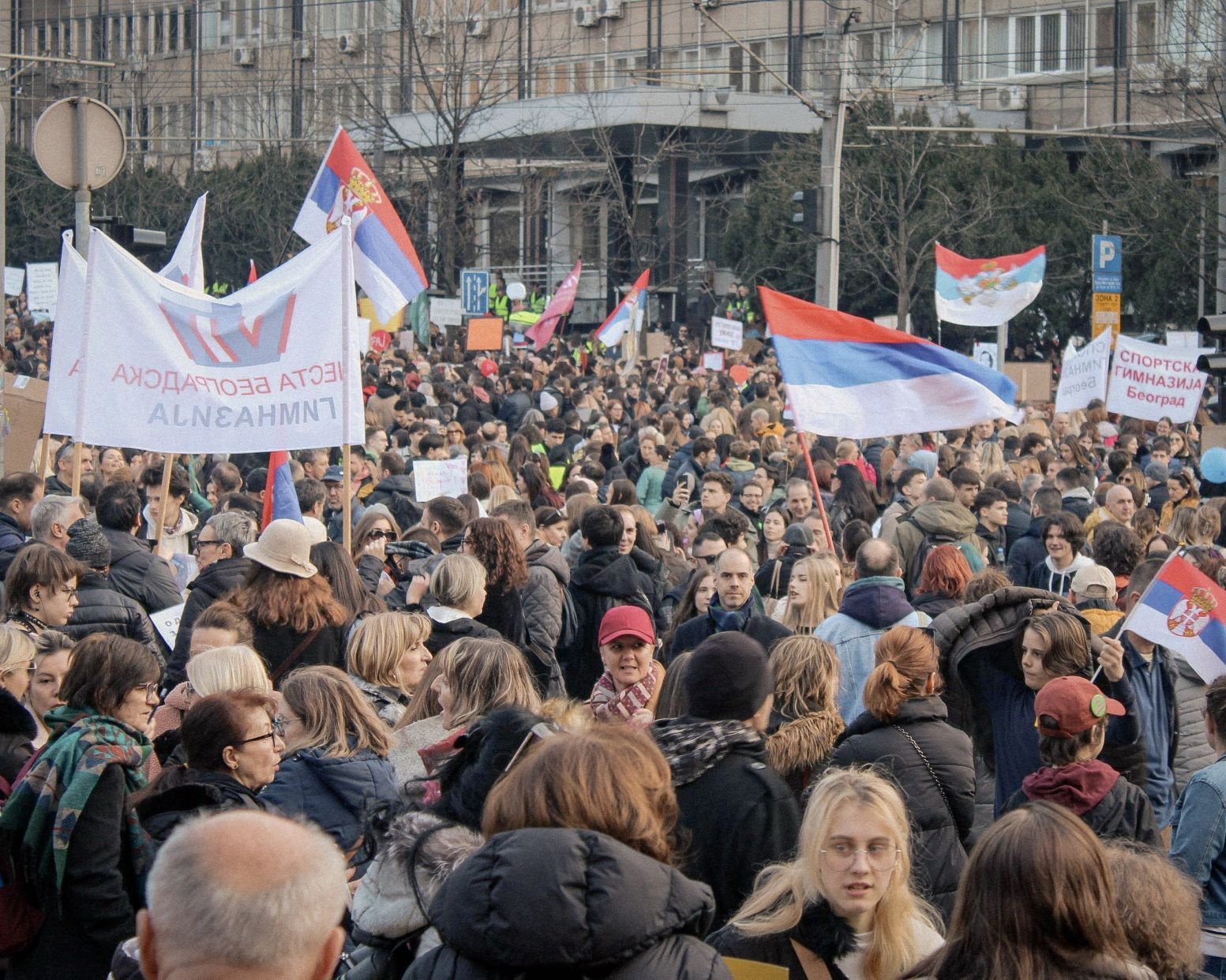
The student blockades culminated in a massive rally held in Belgrade on March 15, titled “15 for 15.” Organized marches from across Serbia converged on the capital. While the Ministry of Interior reported 107,000 participants, independent sources estimated over 300,000 — making it one of the largest protests in Serbia’s modern history. The main gathering point was the plateau in front of the National Assembly, with overflow crowds filling surrounding streets.
Student security volunteers, alongside police, maintained order. Two stages were set up — one at the Assembly and another at Slavija Square. Due to safety assessments, the central event was moved to Slavija, where students read their official demands. At 7:00 p.m., a fifteen-minute moment of silence honored the victims, but at 7:11 p.m., panic erupted on Kralja Milana Street as the crowd suddenly split in two, causing fear and confusion.
Although the protest was largely peaceful, isolated incidents, arrests, and injuries were reported. The students quickly distanced themselves from the disturbances and declared the rally over. The unexplained 7:11 incident — which fueled speculation about the possible use of acoustic weapons — led to the formulation of a fifth demand: an official investigation into the event.
In response to government reprisals against teachers — including pay cuts, dismissals of temporary staff, and other forms of pressure — students organized a new protest titled “Everyone to the Bridge — Enough Is Enough,” held on March 26, 2025, near Branko’s Bridge in Belgrade, in solidarity with teachers whose rights and dignity had been severely undermined.
CYCLING FOR HUMAN RIGHTS AND JUSTICE
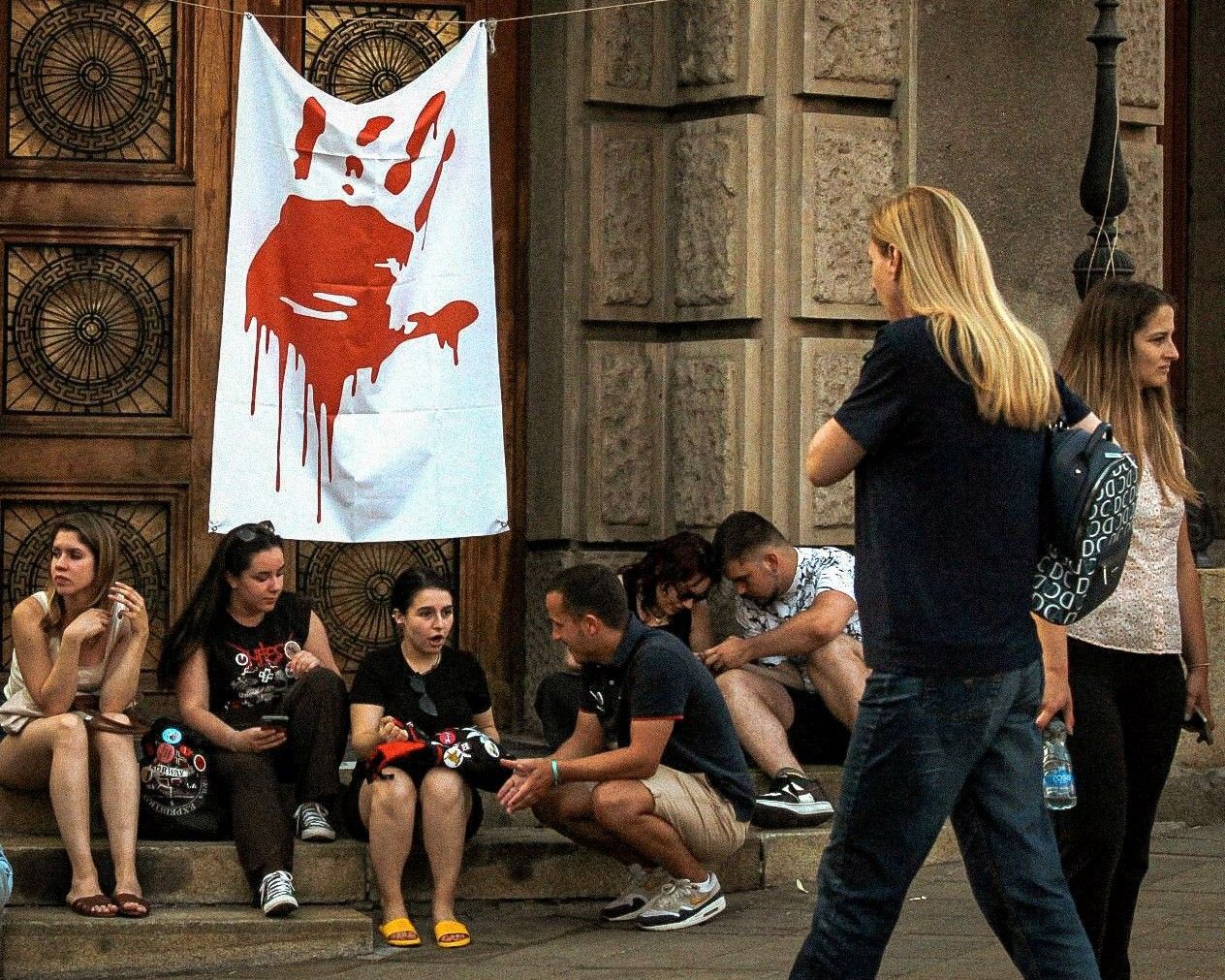
Early April was marked by an action targeting international institutions: the Ride to Strasbourg. Eighty Serbian students cycled from Novi Sad to Strasbourg — the seat of the Council of Europe, of which Serbia is a member — to draw attention to human rights violations and institutional inaction in Serbia.
Departing on April 3, the cyclists covered more than 1,400 kilometers in twelve days, passing through Budapest, Vienna, and Munich, where they were welcomed by local officials. They arrived in Strasbourg on April 15 and delivered letters to the Council of Europe and the European Parliament, urging international institutions to respond to the deteriorating human rights situation in Serbia.
BLOCKADE AGAINST BLOCKADE
April also saw the blockade of the Radio Television of Serbia (RTS) buildings in Takovska Street and Košutnjak, beginning on April 14, 2025. Students organized the action to demand reforms in public media and greater transparency, particularly in the selection of members of the Regulatory Authority for Electronic Media (REM).
After 14 days, on April 28, the RTS blockade ended following an agreement to reopen the selection process for REM council members, ensuring greater accountability and impartiality. Shortly after, 18 candidates withdrew their nominations over legal violations, once again halting the process.
In early May, students formally called for early parliamentary elections, announcing plans to intensify protests if their demands were not met.
THE MARATHON TO THE EU
May also brought the Relay Run to Brussels — a symbolic relay marathon from Novi Sad to Brussels, seat of the European Union — as a continuation of the student protest movement and a call for attention from EU institutions. Students emphasized that, despite years of EU accession talks, Serbia still suffers from systemic violations of law, human rights, and democratic norms, due to the persistent failure of its institutions.
The marathon aimed to highlight the slow and opaque nature of Serbia’s EU integration process and to urge EU authorities to stand firmly with the citizens of Serbia in their fight for legality, transparency, and accountability.
Serbia has been in official accession negotiations with the European Union since January 21, 2014, having received candidate status on March 1, 2012.
HIGH SCHOOL BLOCKADES
From December 2024 to June 2025, high school students across Belgrade organized one of the longest and most persistent waves of protests in the recent history of Serbian education.
What began as symbolic walkouts soon evolved into a sustained and organized system of resistance — with student-led blockades, protests, and solidarity gatherings held almost daily.It all started in December 2024, when university students staged a symbolic 15 minutes of silence during lectures. That quiet act quickly spread to high schools.
The XIV Belgrade Gymnasium played a crucial role in organizing the high school protests, together with several other Belgrade gymnasiums. From the beginning of the second semester (January 20, 2025), teachers joined in as well. The XIV Gymnasium kept a detailed diary of events reflecting the atmosphere and organization of the high school blockades in Belgrade and throughout Serbia.
Blocking the School for Better Education
During the ongoing student protests and broader social mobilization, many teachers from elementary and high schools in Belgrade and other cities also joined the demonstrations. Their participation reflected long-standing dissatisfaction with working conditions in the education system, as well as solidarity with the students’ demands for accountability and democratic governance of public institutions.
At the start of the new year, teachers also formed an informal network called PULS — an association of education workers created to coordinate protests and provide organized support.
On December 16, 2024, students from several Belgrade gymnasiums (including the XIV and V Gymnasiums) began blocking their schools. Shortly afterward, they organized the first student plenums — self-organized assemblies where students collectively defined the goals of the blockade and agreed on methods of organization.
The first collective decision was to reject the Ministry of Education’s proposal for an “extended winter break.” With this move, students opposed the Ministry’s plan to start the break early on December 23, 2024, citing “serious security concerns.” The students viewed the measure as an attempt to suppress protests rather than to protect safety.
High school students coordinated their activities with university students, forming safety teams and other working groups modeled after the student protest structure.
A New Energy in Schools
Upon returning from winter break on January 20, 2025, first-year students at the XIV Belgrade Gymnasium also joined the blockade — a first in Serbian education history. Their participation signaled the depth of systemic problems within the school system.
On January 24, the first major high school protest, titled “A Class in Nature,” was held. The march covered several main city streets, symbolically calling for greater recognition of youth voices and more transparency in education policy. Students demonstrated strong organizational discipline, forming their own security teams to ensure a peaceful protest — proof that young people were capable of expressing dissent responsibly and collectively.
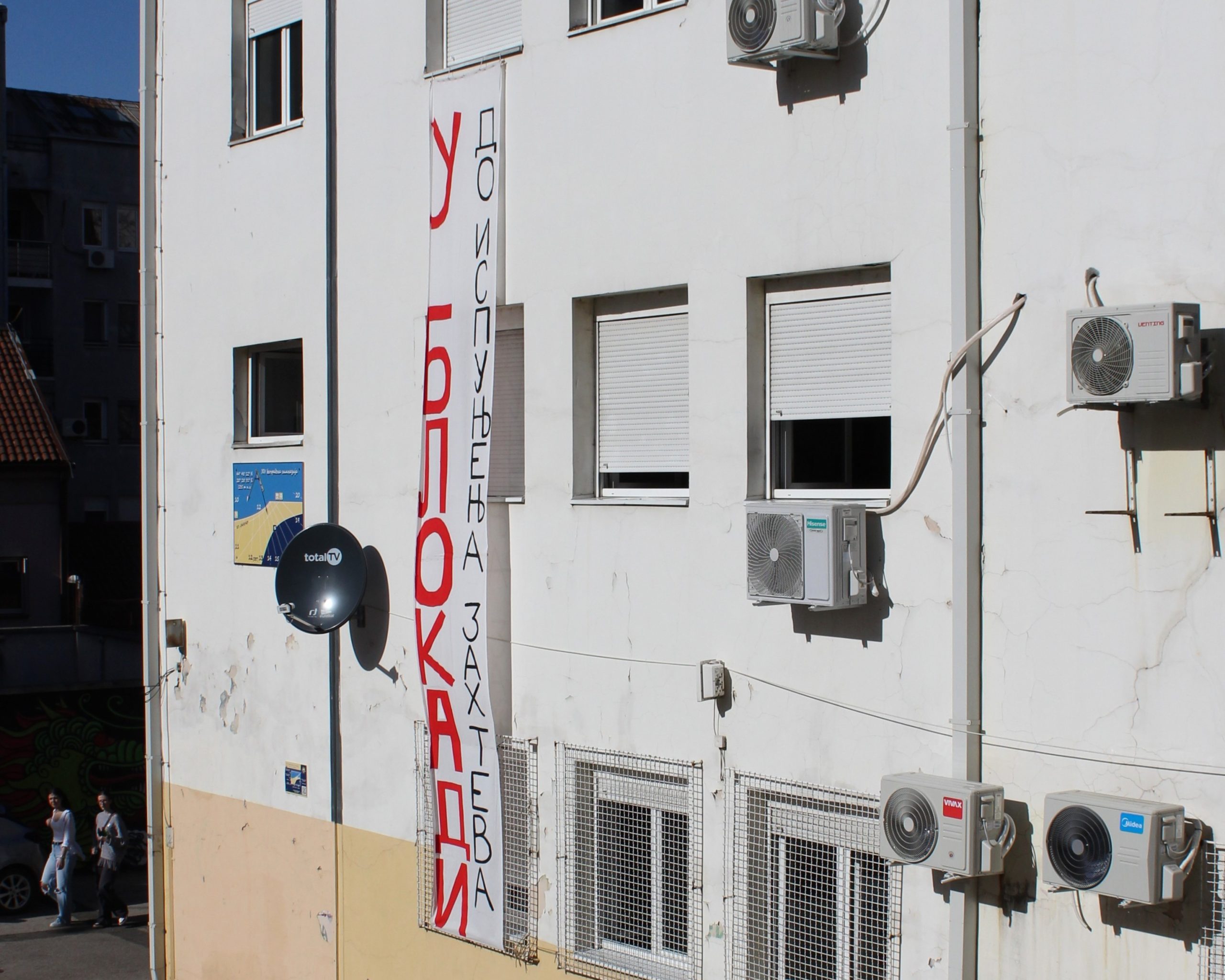
In early February, a series of significant events marked the continuation of the high school movement. On February 3, a solidarity gathering was held in support of the Textile School, and on February 5, students organized a protest in front of the Ministry of Education. Two days later, on February 7, the slogan “In Blockade Until Our Demands Are Met” became the official motto of the movement.
Around this time, students decided to hold independent demonstrations at Kalenić Market, separate from university-led actions. New protests followed: on February 11, another rally took place in front of the Ministry of Education, and on February 12, students gathered in support of the First Belgrade Gymnasium.
On February 14, a Valentine’s Day protest titled “Spread Justice, Spread Love” was organized by high school students. The XIV Gymnasium, together with other Belgrade high schools, played a central role in coordinating the event.
The Fifth Gymnasium and the New Wave of Protests
Following the appointment of a new acting principal at the Fifth Belgrade Gymnasium on February 24, 2025, students and teachers launched protests. On February 27, the school was officially locked down due to alleged “security threats,” preventing both students and staff from entering. Many Belgrade schools gathered outside in solidarity, while the Fifth Gymnasium students continued their blockade — sparking a new wave of demonstrations across the city.
At the end of February, a joint student–high school initiative was launched. From February 25 to 28, around 50 high school students and university students marched from Kragujevac to Niš, walking more than 160 kilometers to show solidarity and commitment to the growing national movement.
Responding to an invitation from the University of Niš, students and citizens from various parts of Serbia gathered in Niš on March 1 for the “Student Edict” protest. The event was not only symbolic but also a practical attempt to unite young people across the country through shared action and mutual respect — an important step in strengthening the student movement.
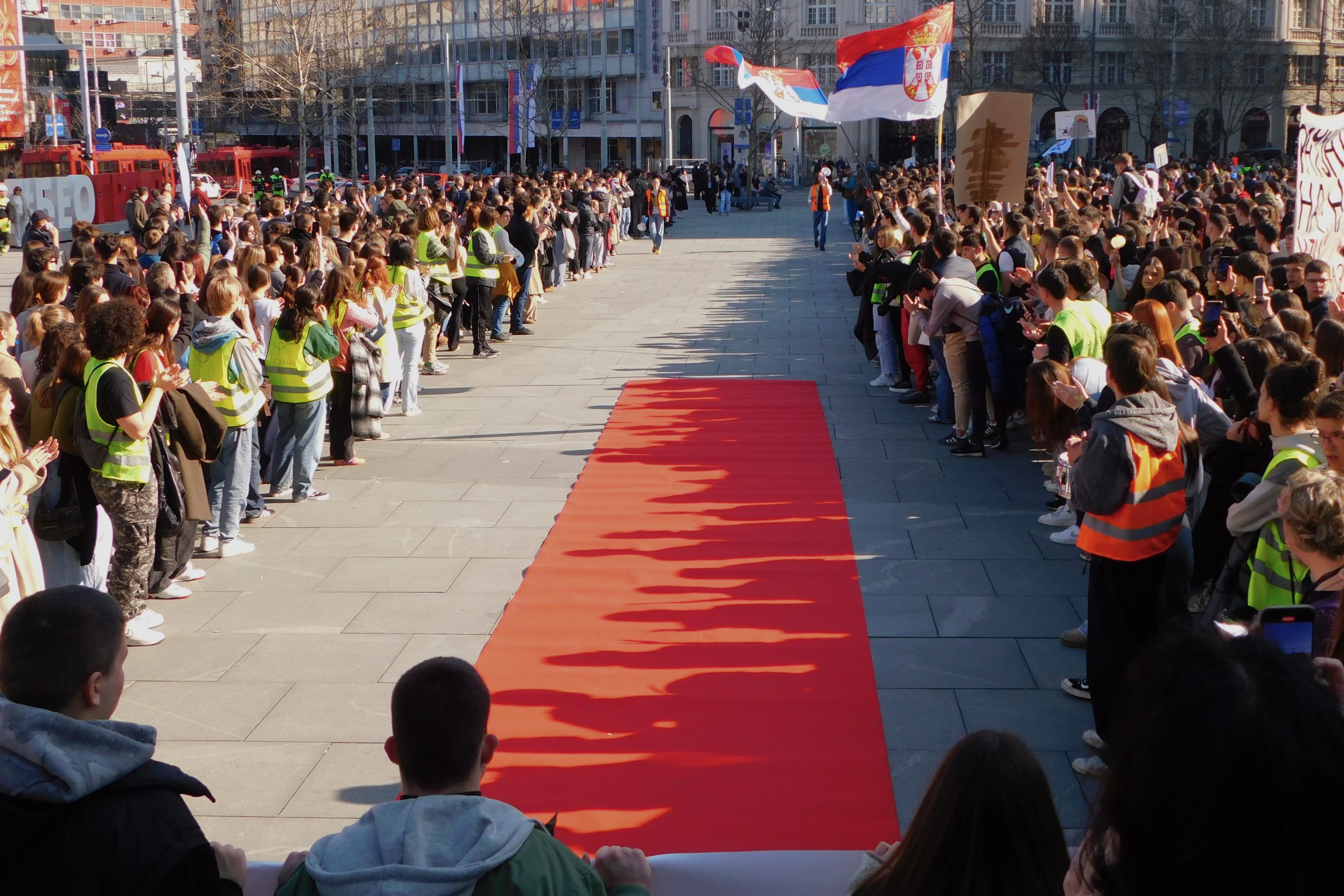
After the Niš protest, on March 4, a ceremonial event titled “Pride of Belgrade” was held at Republic Square to welcome the march participants. During the gathering, student volunteers handed out medals and certificates as tokens of appreciation for engagement and solidarity.
On March 7, the second general strike and protest march took place, following Belgrade’s iconic “Circle of Two” tram route — a well-known loop around the city center — and was organized by Belgrade’s high schools
.
SCHOOL AS A CENTER OF UNITY
In the days leading up to the major “15 for 15” protest in Belgrade, on March 13 and 14, the XIV Belgrade Gymnasium prepared to welcome student marchers arriving from Lajkovac, Ub, and Lazarevac, providing them with accommodation, meals, and strong support through jointly organized activities. This cooperation clearly demonstrated the determination of both students and pupils in their shared struggle for common rights and demands.
That weekend, many Belgrade high schools organized the reception of students from other Serbian cities, offering them lodging and hospitality during the protest. Through donations and local collaboration, schools collected funds, food, bedding, and medical supplies to host the visiting students. The arrivals — students who had walked all the way to Belgrade — were welcomed late in the evening of March 14 directly inside school buildings.
At the height of the protests, on March 15, the largest gathering to date took place. Although university organizers did not allow high school volunteers to take part in security duties directly, schools were present in an organized manner, underscoring the shared commitment to achieving collective goals.
On that day, the XIV Gymnasium opened its doors to students from other cities, providing them with food and accommodation through volunteer efforts. Teachers gave significant support through donations, volunteer shifts, and personal engagement, further expressing solidarity with their students.
Protests in Continuity
Throughout April, the protests remained intense. On March 24, a demonstration was held in front of the ruins of the former General Staff building, and in the following weeks, the multi-week blockade of Radio Television of Serbia (RTS) continued — with volunteers from the XIV Gymnasium actively participating in the protest’s security and logistics teams.
By May, most schools — including the XIV Gymnasium — had returned to regular classes, yet protest activities continued citywide. Daily gatherings were held at 11:52 a.m., along with solidarity events for other schools and joint demonstrations. Two stood out in particular: the rally in front of the Ministry of Education on May 21, and the protest at the intersection of Kralja Milana and Nemanjina Streets on May 23, held under the slogan “Defend the University.” These events marked the movement’s expansion into a broader social and civic cause.
During the summer, high school students did not organize collective protests, but they continued to support teachers whose employment contracts were not renewed due to their participation in school blockades. As a result, dozens of teachers in Belgrade lost their jobs — a development that sparked renewed discontent and solidarity among students.
The new school year began on September 1 as scheduled, but on the very first day, graduating students from Belgrade’s gymnasiums organized a commemorative march through the city under the slogan “High School Students Remember — We Are All Under the Canopy”